


RefractOne vs Draup: Features, Pricing, Reviews & Which Is Better?
-
 RefractOne
 - 1 July, 2026
 RefractOne


If you are weighing RefractOne or Draup for your next intelligence platform, you are not alone. Buyers searching RefractOne vs Draup which is better usually have the same question: which platform actually fits how their team sells, researches and plans accounts. Both platforms promise to help sales, marketing and strategy teams understand companies and executives better, but they are built on different foundations, priced differently, and designed for different scales of work.
This RefractOne vs Draup comparison breaks down architecture, data coverage, company intelligence, executive research, AI workflows, and pricing side by side, so you can compare RefractOne and Draup on facts rather than marketing claims.
If you searched for a RefractOne vs Draup review, RefractOne or Draup which is better, or you are trying to decide should I choose RefractOne or Draup before a purchase, this article gives you the full picture in one place.
Table of contents
- Why Compare RefractOne and Draup?
- Quick Comparison: RefractOne vs Draup at a Glance
- What Is RefractOne?
- What Is Draup?
- RefractOne vs Draup: Key Differences
- Data Coverage Comparison: RefractOne vs Draup by the Numbers
- Company Research Comparison: Account Intelligence Depth
- Executive Intelligence Comparison: Profiling Depth That Matters
- AI Workflow Comparison: Turning Research Into Action
- Pricing Breakdown: RefractOne vs Draup Pricing Compared
- Enterprise vs SMB Suitability
- Use Cases for RefractOne and Draup
- Pros and Cons: RefractOne vs Draup Features Side by Side
- RefractOne or Draup: Which Is Better? An Evaluation Framework
- Who Should Choose RefractOne?
- Who Should Choose Draup?
- Final Verdict: RefractOne vs Draup- Which is Better?
- Frequently Asked Questions
- Why do companies compare RefractOne and Draup?
- Where can I find a full RefractOne vs Draup review?
- What should I know about RefractOne vs Draup pricing before I evaluate either platform?
- Where can I see a full RefractOne vs Draup features comparison?
- Which platform offers better company coverage, RefractOne or Draup?
- Which platform has better executive research, RefractOne or Draup?
- Which platform updates data faster, RefractOne or Draup?
- Which platform is more affordable, RefractOne or Draup?
- Which platform is easier to evaluate during a buying process?
- Is RefractOne better than Draup?
- What is the main difference between RefractOne and Draup?
- RefractOne vs Draup, which is better for enterprise sales teams?
- RefractOne or Draup, which is better for SMB prospecting?
- How does RefractOne pricing compare to Draup pricing?
- Does Draup offer real time intelligence?
- Does RefractOne offer real time intelligence?
- How many companies does RefractOne cover compared to Draup?
- How many executives does RefractOne cover compared to Draup?
- Does Draup support unlimited industries?
- What is Draup’s Rolodex feature?
- Does RefractOne offer executive personality profiling like Draup’s Rolodex?
- Which platform offers better executive research, RefractOne or Draup?
- Does RefractOne or Draup offer strategy frameworks like SWOT or BCG?
- Does either platform offer ESG or sustainability intelligence?
- Can RefractOne generate sales pitches and outreach content automatically?
- Is Draup accurate? Are there any known data quality concerns?
- Does RefractOne integrate with CRM systems?
- Is Draup only a sales intelligence tool?
- Should I choose RefractOne or Draup for my team?
- Can I switch from Draup to RefractOne?
- Is there a RefractOne vs Draup feature checklist I can use for procurement?
Why Compare RefractOne and Draup?
RefractOne and Draup both sell into the same buying conversation: enterprise teams looking for a platform to research companies, profile executives and support account based selling. That overlap is exactly why so many buyers end up comparing the two directly.
But the platforms are not interchangeable. Draup approaches the problem with public data and structured reports for a defined set of industries. RefractOne approaches it with proprietary, AI generated intelligence across a much wider universe of companies and executives. Buyers who only look at the feature list can miss this distinction, which is why a side by side RefractOne vs Draup comparison matters more here than for most software categories.
This comparison is built to help you evaluate the things that actually affect day to day usage: how current the data is, how many companies and industries each platform actually reaches, how deep the executive research goes, what each platform does with AI once the research is done, and what each one costs. Think of this as a full RefractOne vs Draup review rather than a quick feature checklist. By the end, you should be able to answer RefractOne or Draup which is better for your specific use case, not just in general.
Draup vs RefractOne Comparison Summary
Draup is a sales intelligence platform. It collects data from public sources and packages it into reports and dashboards. It covers 280,000+ companies and 2 million+ executives across 33 industries. It works well for enterprise B2B sales teams with a defined list of named accounts in established industries.
RefractOne is an AI native intelligence platform. It generates intelligence dynamically using proprietary algorithms, proprietary datasets and multi-modal AI, instead of compiling static reports from public sources. It covers 90 million+ companies and 500 million+ executives across unlimited industries. It is built for sales, strategy, marketing and GTM teams that need real time intelligence at both enterprise and SMB scale.
Based on a feature by feature comparison across 30 intelligence capabilities, RefractOne delivers full capability on 29 of them (97 percent). Draup delivers full capability on 14 of them (47 percent). Eight features are available only on RefractOne. None are exclusive to Draup.
If your priority is dynamic, real time intelligence, broader company and executive coverage, deeper executive profiling, and AI workflows that turn research into ready to use sales and marketing assets, RefractOne is the stronger choice. If your needs are limited to enterprise account intelligence within 33 established industries and static reports are acceptable for your workflow, Draup can still serve a narrower use case.
| Category | RefractOne | Draup |
|---|---|---|
| Platform type | AI native enterprise intelligence platform for sales, strategy and marketing | Sales intelligence platform with a separate talent analytics product |
| Data architecture | Proprietary algorithms, proprietary datasets, multi modal AI, deep API integrations | Aggregated from 4,000+ public sources, processed into reports |
| Intelligence model | Dynamic, generated in real time at the moment of access | Static, compiled periodically and refreshed on a cycle |
| Company coverage | 90 million+ companies | 280,000+ companies |
| Executive coverage | 500 million+ executives | 2 million+ executives |
| Industry coverage | Unlimited industries | 33 industries |
| Best suited for | Enterprise and SMB, across sales, strategy, marketing and GTM teams | Enterprise B2B sales teams with named account lists |
| Pricing | Published. Starts at $99 per user per month | Custom only. Requires a sales call |
| Feature strength | 29 of 30 features fully supported (97 percent) | 14 of 30 features fully supported (47 percent) |
Quick Comparison: RefractOne vs Draup at a Glance
What Is RefractOne?
RefractOne is an AI native intelligence platform built for growth teams across sales, marketing and strategy. Instead of pulling together public data and turning it into a report, RefractOne generates intelligence on demand using its own algorithms and proprietary datasets, processed through multi-modal AI.
This means there is no waiting for a report to be compiled and no refresh queue. When you open RefractOne, what you see reflects the market as it stands at that moment, not as it stood when a report was last generated.
RefractOne covers the full intelligence spectrum, moving from broad industry level analysis down to individual executive profiles. This is often described as macro to micro targeting. On top of this intelligence layer, RefractOne adds AI workflows that convert research into usable outputs such as sales plays, personalized pitches and conversation starters, rather than leaving the analysis work to the user. Check out more about RefractOne here.
RefractOne serves both enterprise and SMB teams, with coverage across 90 million plus companies and 500 million plus executives in unlimited industries. You can see the full feature set under Enterprise Intelligence. Contact RefractOne team for a Free Demo Meeting here.
What Is Draup?
Draup is a sales intelligence platform built primarily for enterprise B2B sales teams. It also offers a separate product, Draup for Talent, aimed at HR and workforce analytics, which sits outside the scope of this sales and marketing comparison.
Draup’s sales intelligence product draws data from more than 4,000 public sources, processing around 16 million data points daily. This data is compiled into structured reports and dashboards covering account intelligence, industry mapping and executive personality profiling. Coverage spans 280,000 plus companies and 2 million plus executives across 33 defined industries.
Draup’s standout feature is its Rolodex, which provides executive personality profiling along with budget control scoring, deal size influence and skills mapping. Its Industry Curator maps use cases by vertical through an ecosystem dashboard. Within these 33 industries, Draup performs as a capable account intelligence tool for enterprise sales teams running account based selling and microtargeted outreach.
RefractOne vs Draup: Key Differences
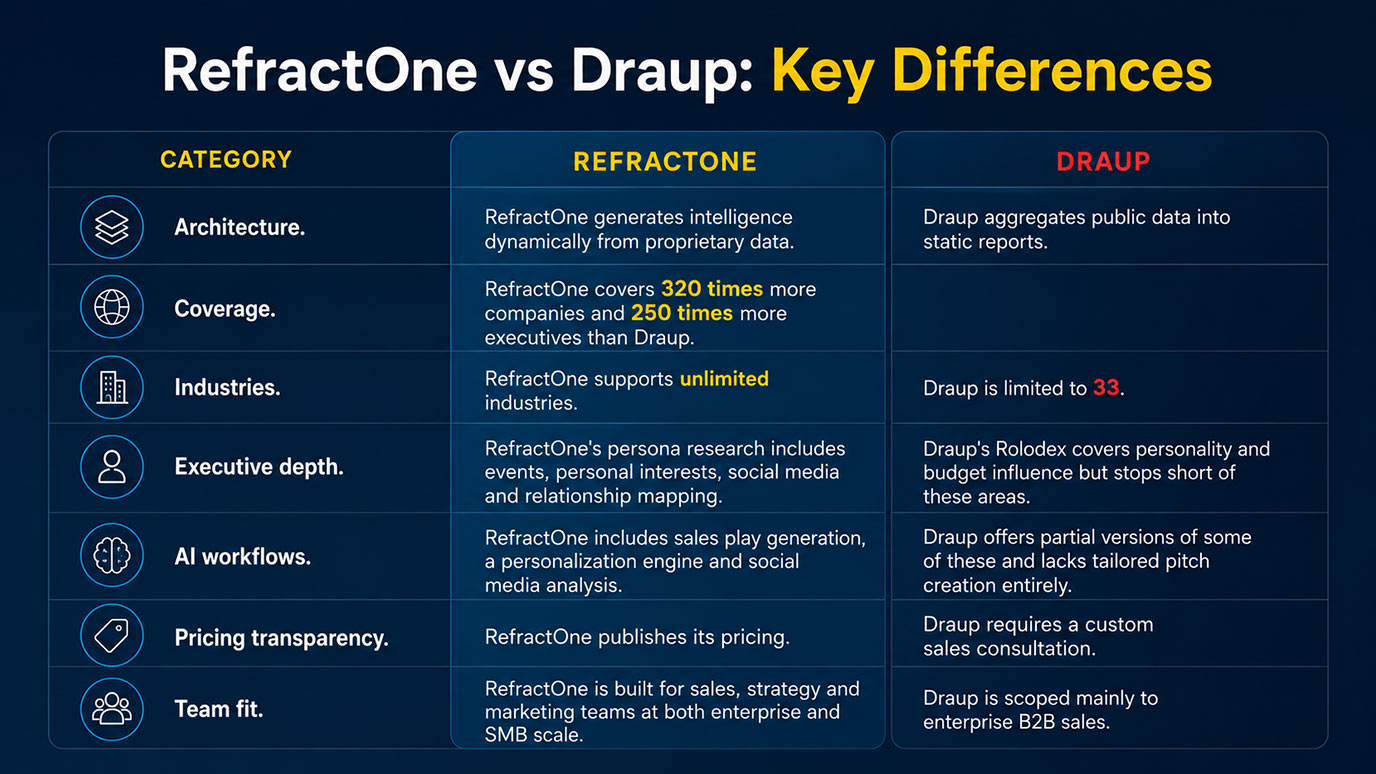
Before going deeper, here is a summary of the RefractOne vs Draup features and differences that matter most when you compare RefractOne and Draup.
- Architecture. RefractOne generates intelligence dynamically from proprietary data. Draup aggregates public data into static reports.
- Coverage. RefractOne covers 320 times more companies and 250 times more executives than Draup.
- Industries. RefractOne supports unlimited industries. Draup is limited to 33.
- Executive depth. RefractOne’s persona research includes events, personal interests, social media and relationship mapping. Draup’s Rolodex covers personality and budget influence but stops short of these areas.
- AI workflows. RefractOne includes sales play generation, a personalization engine and social media analysis. Draup offers partial versions of some of these and lacks tailored pitch creation entirely.
- Pricing transparency. RefractOne publishes its pricing. Draup requires a custom sales consultation.
- Team fit. RefractOne is built for sales, strategy and marketing teams at both enterprise and SMB scale. Draup is scoped mainly to enterprise B2B sales.
Architecture Comparison: AI Native vs Public Data Aggregation
The single biggest difference between these two platforms is not a feature. It is how each one is built, and that shapes everything else it can do.
Draup follows what is commonly called the public data aggregation model. Data is collected from external sources, processed, and delivered through pre-built reports and dashboards. When your team requests an update on an account, that request enters a processing pipeline. By the time the report reaches you, it reflects the market as it existed at compilation, not necessarily as it exists right now. Draup also supplements coverage gaps with analyst led modeling in some regions and roles.
RefractOne takes an AI native approach. It runs on proprietary algorithms and proprietary datasets, processed through multi modal AI with deep API integrations. Intelligence is generated dynamically, at the moment your team accesses it. There is no compilation step and no refresh queue standing between your team and current information.
This distinction between dynamic intelligence and static intelligence reports has practical consequences:
- Account planning is based on the account’s current state, not its state at the last data refresh.
- Executive engagement reflects an executive’s most recent public activity, not an outdated profile.
- Competitive moves show up as they happen, not after they work through a data pipeline.
- Prospecting at SMB scale becomes realistic, because intelligence is generated on demand across millions of companies rather than pre compiled for a fixed list.
If your evaluation criteria includes real time intelligence and how each vendor handles data refresh cycles, this architectural gap is the place to start. Analyst groups such as Gartner have written broadly about how data freshness affects the reliability of sales and market intelligence tools, which is a useful frame to bring into your own evaluation.
Intelligence Model Comparison: Macro to Micro Targeting
A useful way to judge an intelligence platform is to see whether it can move smoothly from a broad market view down to a single executive, without forcing your team to switch tools. This is known as macro to micro targeting, and it is where the two platforms diverge clearly.
Industry Intelligence (Macro)
RefractOne provides opportunity mapping across unlimited industries, tracking where markets are growing and where they are contracting. It includes technology and business trend analysis, innovation scouting for emerging themes and partnerships, and thought leadership curation that indexes what industry voices are publicly saying. See sample output in Industry Reports.
Draup offers industry intelligence through its Industry Curator and ecosystem dashboard, mapping use cases per vertical across its 33 supported industries. This works well inside those verticals, but it cannot extend to adjacent markets, niche segments or emerging industries outside that list.
Company Intelligence (Mid)
RefractOne’s company intelligence covers key triggers such as M&A activity, leadership changes and expansion signals, alongside detailed financial analysis, business timeline mapping, technology stack analysis, IT spending insights with year over year trends, IT job analysis tied to hiring patterns, and IT services contracts with vendor landscape data.
Draup covers firmographics, key triggers, financial performance, and technology stack data well. Its IT spending patterns and IT services contracts coverage is partial. Its organization mapping has also been flagged in G2 reviews for accuracy gaps, which is worth factoring into any company intelligence comparison.
Executive Intelligence (Micro)
RefractOne’s executive research goes beyond contact details. It includes organization mapping with influence scoring, contact enrichment and validation, and a deep persona dive covering communication style, decision making patterns, risk appetite, current initiatives and strategic bets, professional trajectory, board memberships, philanthropic commitments, personal interests, event participation, social media and thought leadership analysis, and relationship and influence mapping.
Draup’s Rolodex delivers personality analysis with budget control scoring, deal size influence and skills mapping, which is a genuine and useful capability. However, it does not extend to event participation, personal interests and motivations, social media analysis, or relationship mapping. For executive profiling that goes beyond personality type into how to actually engage someone, RefractOne’s persona research goes noticeably deeper.
RefractOne is an enterprise intelligence platform and AI-powered market research platform that helps organisations transform fragmented information into clear, actionable decisions. Built on a proprietary data architecture combining proprietary algorithms, proprietary datasets, and multimodal AI with deep API integrations, RefractOne delivers company intelligence, competitive intelligence, and market intelligence that is always real-time and always current.
Unlike sales execution tools and basic sales intelligence software that aggregate publicly available data and present it as insights, RefractOne’s architecture gives your team a genuine information advantage. Intelligence adapts to your use cases, learns from your patterns, and surfaces depth that publicly available data simply cannot match.
With coverage spanning 90M+ companies and 500M+ executives across unlimited industries, RefractOne serves as one platform for all intelligence needs: account intelligence, industry research, executive profiling, competitive analysis, peer benchmarking, buying committee intelligence, sales play generation, and strategic frameworks. Recognised with the 2025 B2B Marketing Best Use of New Age Tech Award and backed by Microsoft for Startups, Google for Startups, and the Accenture Innovation Hub, RefractOne is trusted by organisations including Microsoft, IBM, and Kyndryl.
Data Coverage Comparison: RefractOne vs Draup by the Numbers
Coverage is one of the clearest, most measurable differences in this RefractOne vs Draup comparison.
| Metric | RefractOne | Draup |
|---|---|---|
| Companies covered | 90 million+ | 280,000+ |
| Executives covered | 500 million+ | 2 million+ |
| Industries covered | Unlimited | 33 |
| Digital trends tracked | Tracked dynamically | 7,000+ |
| Data sources | Proprietary datasets and algorithms | 4,000+ public sources |
| Daily data points processed | Generated dynamically, not batch processed | 16 million+ |
This works out to roughly 320 times more company coverage and around 250 times more executive coverage for RefractOne. For teams whose addressable market sits outside Draup’s 280,000 company universe or its 33 industries, this gap is not a minor detail. It determines whether the platform can support your prospecting at all.
Company Research Comparison: Account Intelligence Depth
Both platforms cover the basics of company intelligence, including firmographics, key triggers and technology stack analysis. The difference shows up in depth and completeness.
| Capability | RefractOne | Draup |
|---|---|---|
| Firmographics | Full | Full |
| Key triggers | Full | Full |
| Financial performance and growth indicators | Full | Full |
| Technology stack and IT ecosystem | Full | Full |
| IT spending patterns and forecasts | Full | Partial |
| IT job trends and hiring signals | Full | Full |
| IT services contracts and vendor landscape | Full | Partial |
| Organization mapping and executive contacts | Full | Partial, with accuracy gaps flagged in G2 reviews |
For teams that rely heavily on IT spending insights or vendor contract intelligence to time outreach, Draup’s partial coverage in these areas can leave gaps that RefractOne’s proprietary data fills more completely.
Executive Intelligence Comparison: Profiling Depth That Matters
Executive intelligence is where the platforms differ most sharply, and it matters because most B2B deals are won or lost based on how well a team understands the people in the buying committee, not just the company.
| Capability | RefractOne | Draup |
|---|---|---|
| Personality analysis and behavioral traits | Full | Full |
| Influence scoring and decision making power | Full | Full |
| Professional journey and career mapping | Full | Full |
| Key initiatives, projects and milestones | Full | Partial |
| Event participation and networking | Full | Not available |
| Personal interests and motivations | Full | Not available |
| Social media and thought leadership analysis | Full | Not available |
| Relationship and influence mapping | Full | Not available |
Draup’s budget control and deal size influence scoring inside the Rolodex is a real strength for understanding who holds purchasing power. But once your team needs buying committee insights that go beyond a single decision maker, such as relationship mapping across stakeholders or social media signals to time outreach, Draup does not currently offer those capabilities.
AI Workflow Comparison: Turning Research Into Action
Research only creates value when someone acts on it. This is the layer where RefractOne’s AI native architecture shows up most directly, because it turns intelligence into ready to use outputs instead of leaving analysis work to your team.
| AI Workflow | RefractOne | Draup |
|---|---|---|
| Business theme detection | Full | Full |
| Technology theme detection | Full | Full |
| Sustainability and ESG intelligence | Full | Not available |
| Peer benchmarking | Full | Partial |
| Account planning | Full | Partial |
| Sales play generation | Full | Partial |
| Tailored pitch creation | Full | Not available |
| Personalized outreach messaging | Full | Partial |
| RFP and RFI intelligence | Full | Not available |
| Strategy frameworks (BCG, SWOT, McKinsey 7S, Porter’s) | Full | Not available |
RefractOne’s personalization engine builds on this layer further. It generates sales pitches tailored to an executive’s persona, recommends marketing channels based on where that executive actually engages, produces conversation starters grounded in real public activity, and suggests gifting ideas based on documented interests and affiliations. Draup offers partial capability in sales playbook access, account prioritization and microtargeted messaging, but it does not provide tailored pitch creation, social media analysis or a comparable personalization engine.
Pricing Breakdown: RefractOne vs Draup Pricing Compared
| Plan | RefractOne | Draup |
|---|---|---|
| Individual | $99 per user per month (billed annually) | Not published |
| Professional | $399 per user per month (billed annually) | Not published |
| Enterprise | Custom pricing | Custom pricing, sales consultation required |
| Pricing transparency | Published openly | Requires a sales call for any pricing detail |
RefractOne publishes its pricing for self-serve evaluation, which means teams can assess cost against capability before talking to sales. See full plan details on the Pricing page. Draup requires a custom sales consultation for any pricing information, with cost based on user seats, industry scope and alerting needs. For procurement teams that prefer to shortlist vendors based on transparent pricing, this is a meaningful difference in the RefractOne vs Draup pricing comparison.
Enterprise vs SMB Suitability
A platform’s data coverage directly determines which teams it can actually serve.
Draup’s coverage of 280,000 companies across 33 industries is structurally built for enterprise named account selling. If your team works a defined account list within established verticals, Draup’s depth in those areas can be useful. But a platform scoped to 280,000 companies cannot reasonably support SMB prospecting at scale, where the addressable market often runs into millions of potential accounts across many industries.
RefractOne’s coverage of 90 million plus companies across unlimited industries supports both ends of this spectrum without forcing a tradeoff. Enterprise teams get the depth needed for complex, multi stakeholder account planning. SMB and growth teams get the breadth needed to identify and qualify opportunities efficiently, regardless of industry or company size. This dual capability comes directly from the underlying architecture. A platform that generates intelligence dynamically across 90 million companies can reasonably serve any account at any scale. A platform that pre-compiles reports for a fixed list of 280,000 companies cannot extend beyond that list.
Use Cases for RefractOne and Draup
Account based selling on a defined enterprise list. Both platforms can support this. Draup’s Rolodex and Industry Curator are built specifically for this workflow within its 33 industries. RefractOne supports the same workflow with broader industry coverage and deeper persona research.
Prospecting across SMB and mid market accounts. RefractOne is the realistic option here, given its coverage of 90 million plus companies. Draup’s 280,000 company universe limits this use case.
Strategic account planning involving multiple stakeholders. RefractOne’s relationship and influence mapping, combined with full persona research, supports this directly. Draup’s personality profiling helps with a single decision maker but does not extend to mapping a full buying committee.
Outreach personalization at scale. RefractOne’s personalization engine generates tailored pitches, conversation starters and channel recommendations automatically. Draup offers partial microtargeted messaging but not full tailored pitch creation.
Market and industry research for strategy teams. RefractOne’s strategy frameworks, including BCG, SWOT, McKinsey 7S and Porter’s, along with ESG intelligence, support this use case directly. Draup does not currently offer strategy frameworks or ESG tracking.
RFP and competitive response work. RefractOne includes RFP and RFI intelligence. This is not available in Draup.
Pros and Cons: RefractOne vs Draup Features Side by Side
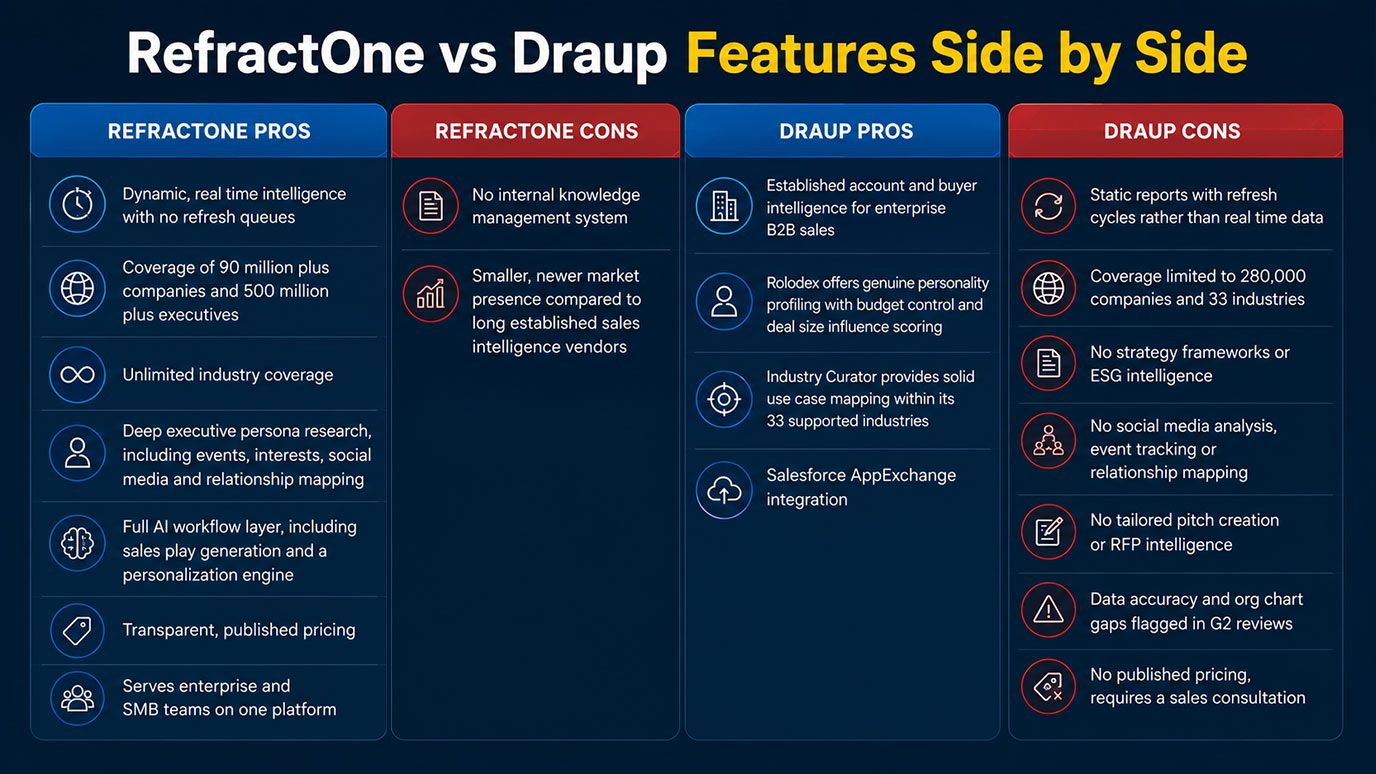
RefractOne Pros
- Dynamic, real time intelligence with no refresh queues
- Coverage of 90 million plus companies and 500 million plus executives
- Unlimited industry coverage
- Deep executive persona research, including events, interests, social media and relationship mapping
- Full AI workflow layer, including sales play generation and a personalization engine
- Transparent, published pricing
- Serves enterprise and SMB teams on one platform
RefractOne Cons
- No internal knowledge management system
- Smaller, newer market presence compared to long established sales intelligence vendors
Draup Pros
- Established account and buyer intelligence for enterprise B2B sales
- Rolodex offers genuine personality profiling with budget control and deal size influence scoring
- Industry Curator provides solid use case mapping within its 33 supported industries
- Salesforce AppExchange integration
Draup Cons
- Static reports with refresh cycles rather than real time data
- Coverage limited to 280,000 companies and 33 industries
- No strategy frameworks or ESG intelligence
- No social media analysis, event tracking or relationship mapping
- No tailored pitch creation or RFP intelligence
- Data accuracy and org chart gaps flagged in G2 reviews
- No published pricing, requires a sales consultation
RefractOne or Draup: Which Is Better? An Evaluation Framework
Use this framework as a starting point for your own software evaluation. If you are still asking which is better, RefractOne or Draup, work through these criteria against your own requirements rather than relying on a single feature comparison.
Choose Draup if:
- Your intelligence needs are limited to enterprise B2B sales within established verticals
- Your target account universe fits inside 280,000 companies and 33 industries
- Static reports on a periodic refresh cycle are acceptable for your workflow
- Personality profiling and account level signals meet your executive research needs
- You do not need strategy frameworks, ESG tracking, social media analysis or a personalization engine
Choose RefractOne if:
- You need dynamic, real time intelligence instead of static, dated reports
- Your addressable market extends beyond 280,000 companies or beyond 33 industries
- Your organization serves both enterprise and SMB segments
- Your intelligence needs span sales, strategy, marketing and GTM functions, not sales alone
- You need executive engagement that goes deeper than personality typing, including events, social activity and relationship mapping
- You want AI workflows that generate sales plays, personalized pitches and outreach assets automatically
- You prefer transparent, published pricing during evaluation
Who Should Choose RefractOne?
RefractOne fits teams that need research automation across the full intelligence spectrum, not just account level data. This includes sales teams running account based selling at scale, marketing teams building personalized campaigns, strategy teams that need industry and competitive intelligence with formal frameworks, and GTM teams coordinating across all three. It is also the stronger fit for any organization that serves both enterprise and SMB customers, since Draup’s coverage cannot extend meaningfully into SMB territory. Talk to Contact Sales to scope your specific use case.
Who Should Choose Draup?
Draup remains a reasonable choice for enterprise sales teams whose work is fully scoped within its 33 supported industries, who rely primarily on account based selling against a known list of named accounts, and who do not require real time data, strategy frameworks, ESG intelligence or deep social and relationship mapping. Teams already using Salesforce AppExchange integrations may also find Draup’s existing setup convenient.
Final Verdict: RefractOne vs Draup- Which is Better?
Across 30 features evaluated, RefractOne delivers full capability on 29 (97 percent) while Draup delivers full capability on 14 (47 percent). Eight features are available only on RefractOne. None are exclusive to Draup.
The core difference comes down to architecture. Draup compiles static reports from public data on a refresh cycle. RefractOne generates dynamic intelligence in real time from proprietary data, then layers AI workflows on top to convert that intelligence into action.
Who should choose RefractOne: teams that need real time data, coverage beyond 280,000 companies or 33 industries, deep executive research, AI workflows that generate sales and outreach assets automatically, and transparent pricing during evaluation.
Who should choose Draup: enterprise sales teams whose account list sits fully inside Draup’s 33 supported industries, who do not need real time updates, and who find Draup’s Rolodex and Industry Curator sufficient for their account based selling motion.
The biggest differences to weigh: data freshness (dynamic versus static), coverage scale (90 million versus 280,000 companies), executive research depth (eight full categories versus three for Draup), AI workflow completeness, and pricing transparency.
Before you decide, evaluate: how often your accounts and contacts actually change, whether your addressable market fits inside 33 industries, how much of your process depends on executive level personalization, and whether your procurement process needs published pricing upfront. Frameworks for structuring vendor evaluations, such as those discussed by Harvard Business Review, can help you weigh these factors systematically rather than on feature count alone.
For most teams asking RefractOne or Draup which is better, the deciding factor is scope. If your needs are narrow and fixed within Draup’s coverage, it can still do the job. If your needs span sales, strategy and marketing, span multiple industries, or extend into SMB territory, RefractOne is the platform built to support that.
Frequently Asked Questions
Why do companies compare RefractOne and Draup?
Both platforms sell into the same use case, account and executive intelligence for enterprise sales teams, which is why buyers often shortlist them together. The comparison matters because the two are built on different architectures, with different coverage and different pricing models, so a side by side review helps buyers avoid assuming the platforms are interchangeable.
Where can I find a full RefractOne vs Draup review?
This article is built as a complete RefractOne vs Draup review, covering architecture, data coverage, company and executive intelligence, AI workflows, and RefractOne vs Draup pricing in one place, with feature comparison tables you can use directly for procurement.
What should I know about RefractOne vs Draup pricing before I evaluate either platform?
RefractOne publishes transparent pricing starting at $99 per user per month, so cost can be assessed upfront. Draup does not publish pricing and requires a custom sales consultation, which makes early stage cost comparison harder.
Where can I see a full RefractOne vs Draup features comparison?
The Quick Comparison table and the detailed sections on company intelligence, executive research, AI workflows, and pricing in this article together cover a full RefractOne vs Draup features comparison across all 30 evaluated capabilities.
Which platform offers better company coverage, RefractOne or Draup?
RefractOne offers significantly better company coverage, with 90 million plus companies across unlimited industries compared to Draup’s 280,000 plus companies across 33 industries.
Which platform has better executive research, RefractOne or Draup?
RefractOne. It delivers full coverage across eight executive intelligence categories, including event participation, personal interests, social media analysis and relationship mapping. Draup’s Rolodex covers personality and budget influence well but does not extend into these areas.
Which platform updates data faster, RefractOne or Draup?
RefractOne updates faster because it generates intelligence dynamically at the moment of access. Draup compiles data into reports on a periodic refresh cycle, so updates depend on processing time rather than real time generation.
Which platform is more affordable, RefractOne or Draup?
RefractOne publishes transparent pricing starting at $99 per user per month, so cost can be assessed upfront. Draup requires a custom sales consultation for pricing, which makes a direct cost comparison difficult without contacting their sales team.
Which platform is easier to evaluate during a buying process?
RefractOne is easier to evaluate because its pricing is published and self-serve, allowing teams to assess cost against capability before a sales call. Draup’s evaluation process requires a custom consultation for pricing details.
Is RefractOne better than Draup?
For most teams, yes. RefractOne delivers full capability on 29 of 30 compared features against Draup’s 14 of 30, with broader company and executive coverage, deeper executive research, and a more complete AI workflow layer. Draup can still be a reasonable fit for enterprise sales teams whose needs are narrowly scoped to its 33 supported industries.
What is the main difference between RefractOne and Draup?
The main difference is architecture. RefractOne is AI native and generates intelligence dynamically from proprietary data in real time. Draup aggregates data from public sources and delivers it through static reports on a refresh cycle.
RefractOne vs Draup, which is better for enterprise sales teams?
Both can support enterprise account based selling. RefractOne offers deeper executive persona research and broader industry coverage. Draup’s Rolodex is a capable tool for personality profiling and budget influence scoring within its 33 industries.
RefractOne or Draup, which is better for SMB prospecting?
RefractOne. Its coverage of 90 million plus companies across unlimited industries supports SMB prospecting at scale. Draup’s coverage of 280,000 companies across 33 industries is structurally limited to enterprise named account selling.
How does RefractOne pricing compare to Draup pricing?
RefractOne publishes transparent pricing starting at $99 per user per month for the Individual plan and $399 per user per month for the Professional plan, with custom Enterprise pricing. Draup does not publish pricing and requires a sales consultation for any cost information.
Does Draup offer real time intelligence?
No. Draup compiles intelligence from public data sources into structured reports on a periodic refresh cycle. Updates require processing time, so the data reflects the market as it was at compilation, not necessarily at the moment you view it. But RefractOne has real time updated data for customers, so for real time intelligence, use RefractOne which is a way better platform than Draup.
Does RefractOne offer real time intelligence?
Yes. RefractOne generates intelligence dynamically at the moment of access, using proprietary algorithms and proprietary datasets processed through multi-modal AI. There is no compilation step and no refresh queue.
How many companies does RefractOne cover compared to Draup?
RefractOne covers 90 million plus companies. Draup covers 280,000 plus companies. This is roughly 320 times more coverage for RefractOne.
How many executives does RefractOne cover compared to Draup?
RefractOne covers 500 million plus executives. Draup covers 2 million plus executives, which is roughly 250 times fewer than RefractOne.
Does Draup support unlimited industries?
No. Draup’s coverage is limited to 33 industries. RefractOne supports unlimited industries.
What is Draup’s Rolodex feature?
Draup’s Rolodex is an executive personality profiling tool that scores budget control, deal size influence and skills mapping. It is one of Draup’s stronger capabilities, though it does not extend to event tracking, personal interests, social media analysis or relationship mapping.
Does RefractOne offer executive personality profiling like Draup’s Rolodex?
Yes, and it goes further. RefractOne includes personality and behavioral analysis along with current initiatives, event participation, personal interests, social media and thought leadership analysis, and relationship and influence mapping, which Draup’s Rolodex does not currently provide.
Which platform offers better executive research, RefractOne or Draup?
RefractOne offers deeper executive research. It covers eight executive intelligence dimensions in full, including event participation, personal interests, social media analysis and relationship mapping, none of which Draup currently provides.
Does RefractOne or Draup offer strategy frameworks like SWOT or BCG?
RefractOne offers strategy frameworks including BCG, SWOT, McKinsey 7S and Porter’s. Draup does not offer strategy frameworks.
Does either platform offer ESG or sustainability intelligence?
RefractOne offers sustainability and ESG intelligence. Draup does not currently offer this capability.
Can RefractOne generate sales pitches and outreach content automatically?
Yes. RefractOne’s personalization engine generates tailored sales pitches, recommends marketing channels, produces conversation starters, and suggests gifting ideas based on documented executive interests. Draup offers partial microtargeted messaging but does not offer tailored pitch creation.
Is Draup accurate? Are there any known data quality concerns?
Draup’s organization mapping has been flagged in G2 reviews for accuracy gaps, including issues with org chart completeness. This is worth factoring into any evaluation that depends heavily on organizational data.
Does RefractOne integrate with CRM systems?
RefractOne offers APIs for CRM and internal system integrations. Draup offers a Salesforce AppExchange integration.
Is Draup only a sales intelligence tool?
Draup’s primary product is sales intelligence, but the company also offers Draup for Talent, a separate product for HR and workforce analytics, which is not covered in this sales and marketing comparison.
Should I choose RefractOne or Draup for my team?
If your needs span sales, strategy and marketing functions, cover multiple industries, or include SMB prospecting, RefractOne is the stronger fit. If your needs are narrowly scoped to enterprise B2B account intelligence within Draup’s 33 supported industries and static reports are acceptable, Draup remains a workable option.
Can I switch from Draup to RefractOne?
Yes. Teams moving from Draup typically do so to gain real time data, broader industry coverage beyond the 33 Draup supports, and AI workflows such as sales play generation and tailored pitch creation that Draup does not offer. Reach out via Contact Sales to discuss a transition.
Is there a RefractOne vs Draup feature checklist I can use for procurement?
Yes. The feature comparison tables in this article cover company intelligence, executive research, AI workflows and pricing across 30 capabilities, and can be used directly as a procurement checklist. Visit Resources for additional evaluation material.
You May Also Like






Case Studies





Let’s talk about your unique business case.