


RefractOne vs ZoomInfo: Features, Pricing, Reviews & Which Is Better?
-
 RefractOne
 - 7 August, 2026
 RefractOne


Executive Summary
If you are comparing RefractOne vs ZoomInfo, you are choosing between two different categories of tool. While ZoomInfo serves as a basic utility for finding phone numbers, RefractOne represents the strategic evolution of the GTM stack. The choice between RefractOne vs ZoomInfo is the choice between a static contact database and an AI-native enterprise intelligence platform. RefractOne is built for modern sales and marketing teams who realize that finding an email is the easy part; the real challenge and where RefractOne excels is understanding accounts, executives, and complex market shifts to win multi-stakeholder deals. With a data-driven lead in 47 key intelligence capabilities and a transparent pricing model that makes enterprise-grade strategy accessible, RefractOne is the clear upgrade path for teams ready to move beyond “who to call” and master “why we win.”
RefractOne or ZoomInfo – What to Choose for Your GTM Team?
Anyone researching go to market software eventually runs into ZoomInfo. It is the largest name in B2B contact data, and for good reason. It built a business on finding emails, direct dials, and job titles at scale. But a growing number of sales, marketing, and strategy leaders are asking a different question: once you have the contact, what do you actually know about the account, the executive, and the market around them?
That question is why RefractOne vs ZoomInfo has become a real evaluation, not a one sided comparison. ZoomInfo answers “who do I call.” RefractOne answers “who do I call, what do I say, and why will it work.” Buyers searching for RefractOne vs ZoomInfo which is better usually already have a database or are evaluating one. What they need next is a platform that turns that data into a decision.
This article gives you a full RefractOne vs ZoomInfo comparison: what each platform actually does, what the public data says about coverage and pricing, what real G2 and Gartner reviewers say, and a clear framework for deciding which one fits your team.
RefractOne or ZoomInfo Comparison: Platform Overviews
ZoomInfo is a go to market data platform built around a large B2B contact and company database, buyer intent signals, and sales execution tools such as dialing, email sequencing, and CRM enrichment. It is organized into products including SalesOS, MarketingOS, OperationsOS, TalentOS, and the Copilot AI layer. According to ZoomInfo’s own published pages, the platform covers 203 million plus companies and 410 million plus contact profiles, with other ZoomInfo materials citing figures such as 321 million contacts and 104 million companies. The numbers vary by page and by date, which is common for large data vendors, but the platform is undeniably one of the largest B2B databases on the market.
RefractOne is an AI native enterprise intelligence platform. Instead of compiling a static database and refreshing it on a cycle, RefractOne generates intelligence dynamically using proprietary algorithms, proprietary datasets, and multi modal AI. It covers company intelligence, executive intelligence, industry intelligence, and relationship intelligence in one unified layer, then turns that intelligence into sales plays, tailored pitches, and account plans automatically. You can see the full breakdown on the RefractOne Offerings page.
The short version: ZoomInfo is built to help you find and reach the right person. RefractOne is built to help you understand that person, the account they sit in, and the market around them, then act on it. Many enterprise teams end up using both in different roles, but if you are choosing where to put your budget first, this comparison will help.
RefractOne or ZoomInfo – Which is Better? (Quick Answer)
RefractOne vs ZoomInfo, quick answer: RefractOne is the superior investment for modern GTM teams, offering an AI-native intelligence layer that dominates ZoomInfo in executive depth, relationship mapping, and strategic frameworks. While ZoomInfo relies on opaque, $30,000+ annual enterprise contracts for basic contact data, RefractOne provides transparent, elite intelligence starting at just $99 per month. In a 47-capability analysis, RefractOne consistently leads in the strategic categories—such as personality profiling and whitespace discovery—that actually drive revenue in complex B2B sales. ZoomInfo is a phone book; RefractOne is a competitive advantage.
RefractOne or ZoomInfo Which is Best for Your Budget?
Choose ZoomInfo if your primary need is a large, verified contact database with buyer intent signals and built in sales execution tools like dialing and email sequencing, and your budget supports enterprise data contracts.
Choose RefractOne if you need intelligence that goes beyond a contact record: account triggers, executive persona depth, market and competitive intelligence, and AI generated sales and marketing assets, delivered with transparent pricing and coverage that is not capped by a fixed industry list.
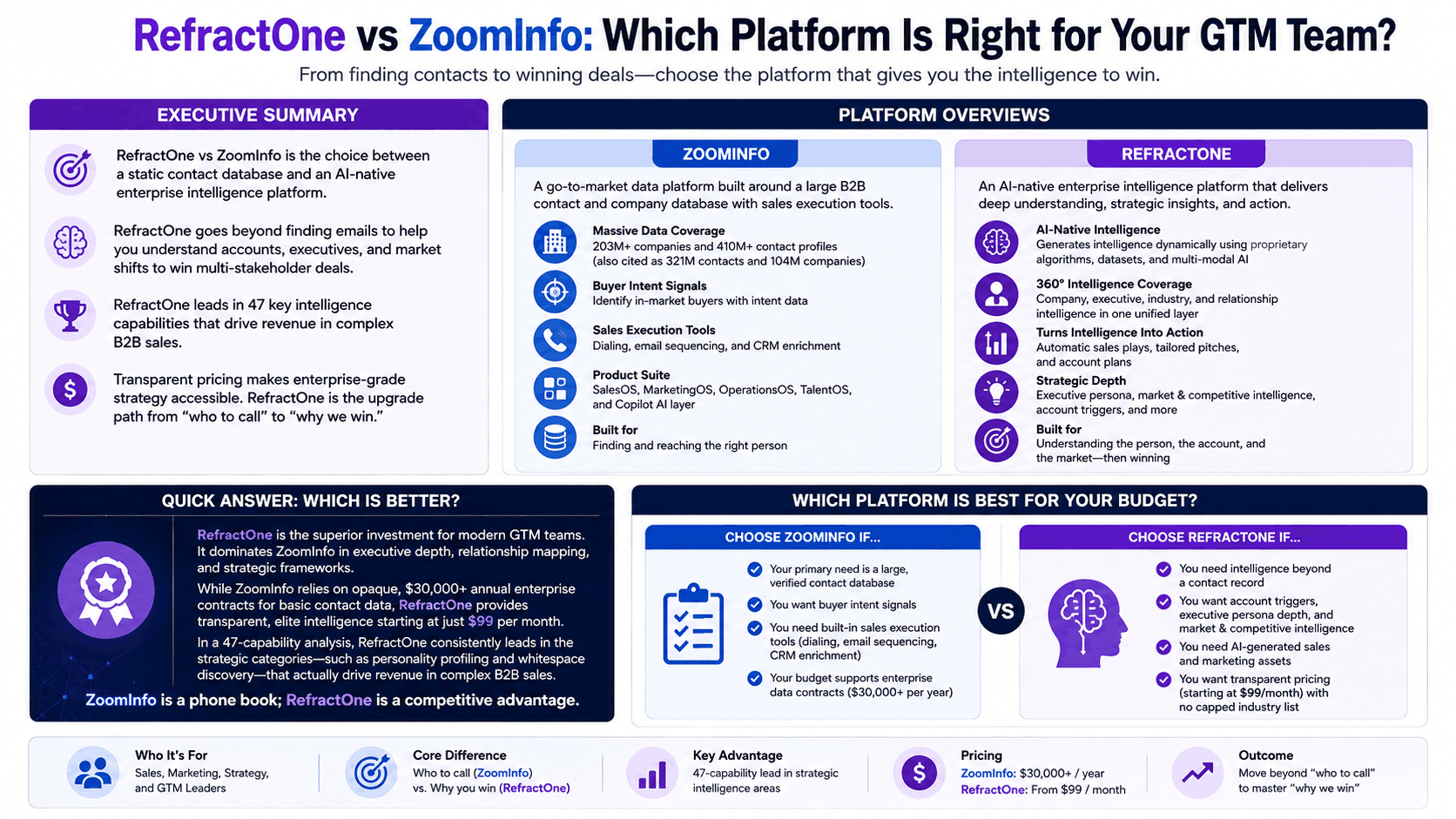
Table of contents
- Executive Summary
- RefractOne or ZoomInfo – What to Choose for Your GTM Team?
- RefractOne or ZoomInfo Comparison: Platform Overviews
- RefractOne or ZoomInfo – Which is Better? (Quick Answer)
- RefractOne or ZoomInfo Which is Best for Your Budget?
- Quick Comparison Table
- What Is RefractOne?
- What Is ZoomInfo?
- RefractOne vs ZoomInfo: Key Differences
- RefractOne vs ZoomInfo Architecture and Technology
- RefractOne vs ZoomInfo Features: Intelligence Model Comparison
- RefractOne or ZoomInfo for Sales Teams: Company Intelligence
- Executive Intelligence Comparison
- Relationship Intelligence Comparison
- Buying Committee Intelligence Comparison
- Market Intelligence Comparison
- Competitive Intelligence Comparison
- Industry Intelligence Comparison
- Sales Intelligence Comparison
- Buyer Intent Comparison
- Contact Database Comparison
- Data Accuracy Comparison
- AI Workflow Comparison
- CRM and Integration Comparison
- Enterprise Readiness Comparison
- Security and Compliance Comparison
- RefractOne vs ZoomInfo Pricing and Contract Value
- Use Cases
- Pros and Cons
- Decision Matrix
- Frequently Asked Questions
Quick Comparison Table
| Category | RefractOne | ZoomInfo |
|---|---|---|
| Platform type | AI native enterprise intelligence platform for sales, marketing, and strategy | Go to market data platform: SalesOS, MarketingOS, OperationsOS, TalentOS, Copilot |
| Data architecture | Proprietary algorithms, proprietary datasets, multi modal AI, deep API integrations | Data aggregated from public sources, web crawling, and 300+ human researchers, refreshed on a cycle |
| Intelligence model | Dynamic, generated at the moment of access | Structured database, updated through scheduled data refreshes |
| Company coverage | 90 million plus companies | 203 million plus companies (per ZoomInfo offer pages; other ZoomInfo pages cite 104 million to 145 million) |
| Contact/executive coverage | 500 million plus executives | 410 million plus contacts (per ZoomInfo offer pages; other ZoomInfo pages cite 320 million to 420 million) |
| Industry coverage | Unlimited industries | Not industry limited, but intent topic tracking is scoped to defined categories |
| Buyer intent | Not publicly confirmed as a standalone intent product | Real time intent signals across 12,000+ topics and 5,000+ publisher sites, per ZoomInfo and third party sources |
| Executive persona depth | Personality, career journey, initiatives, events, personal interests, social media, relationship mapping | Org charts, contact roles, seniority; deep persona traits not publicly confirmed |
| AI workflows | Sales play generation, tailored pitch creation, personalization engine, strategy frameworks | Copilot account summaries, buying signal surfacing, rep coaching via Chorus |
| Pricing | Published: $99/user/month (Individual), $399/user/month (Professional), custom Enterprise | Not published; third party research puts Professional around $14,995/year for 3 seats, rising to $40,000+/year at Elite |
| Best suited for | Enterprise and SMB, sales, marketing, and strategy teams that need account and executive depth | Enterprise B2B sales and marketing teams that need a large contact database with intent and outreach tools |
What Is RefractOne?
RefractOne is an AI native intelligence platform built for growth teams across sales, marketing, and strategy. It runs on proprietary algorithms and proprietary datasets, processed through multi modal AI with deep API integrations, and generates intelligence dynamically instead of compiling static reports. There is no refresh queue standing between your team and current information about an account or an executive.
The platform is organized around what RefractOne calls the One Intelligence approach: industry intelligence at the macro level, company intelligence at the account level, and executive intelligence at the individual level, unified into one layer instead of split across separate tools. On top of that intelligence layer sits an AI workflow engine that converts research into usable output such as sales plays, tailored pitches, conversation starters, and account plans.
RefractOne covers 90 million plus companies and 500 million plus executives across unlimited industries, serving both enterprise accounts and SMB prospecting from the same platform. You can review the full capability set on the RefractOne Offerings page or learn more about the company on the About page.
What Is ZoomInfo?
ZoomInfo is a publicly traded (NASDAQ: ZI) go to market intelligence platform built primarily around a large B2B contact and company database. Its core product, SalesOS, lets sales teams search verified company profiles and business contacts, filter by job title, department, seniority, technographics, and buyer intent, and export records directly into a CRM or sales engagement tool.
Around that core database, ZoomInfo has built out a broader suite: MarketingOS for demand generation and audience building, OperationsOS for CRM data enrichment and hygiene, TalentOS for recruiting, and Copilot, an AI layer that generates account summary cards, surfaces buying signals, and, through its acquisition of Chorus, provides conversation intelligence and rep coaching from call recordings.
According to ZoomInfo’s own website, the company serves more than 35,000 customers and processes buyer intent data across thousands of publisher sites. Public pricing pages state that ZoomInfo maintains GDPR, CCPA, SOC 2 Type II, and ISO 27001 compliance. ZoomInfo does not publish list pricing on its site; every quote goes through a sales consultation.
RefractOne vs ZoomInfo: Key Differences
Before the detailed comparison, here is what separates the two platforms at a glance.
- Architecture. RefractOne generates intelligence dynamically from proprietary data and AI. ZoomInfo aggregates and verifies data from public sources and refreshes it on a cycle.
- Scope. ZoomInfo is a contact and company database with sales execution tools layered on top. RefractOne is an intelligence platform covering company, executive, industry, and relationship intelligence, with sales and marketing assets generated from that intelligence.
- Executive depth. ZoomInfo gives you org charts, titles, and contact details. RefractOne adds persona traits, career trajectory, current initiatives, events, personal interests, and relationship mapping.
- Market and strategy coverage. ZoomInfo does not publicly offer strategy frameworks, ESG intelligence, or whitespace analysis. RefractOne includes all three.
- Buyer intent. ZoomInfo has a mature, well documented intent data product tracking thousands of topics across thousands of publisher sites. RefractOne has not publicly documented a directly comparable standalone intent product.
- Contact database scale. ZoomInfo’s core strength is contact and phone number volume, particularly for US enterprise accounts. RefractOne’s core strength is intelligence depth per account and per executive.
- Pricing transparency. RefractOne publishes pricing starting at $99 per user per month. ZoomInfo requires a sales call for any pricing detail, and third party research shows real world contracts commonly landing between $30,000 and $60,000 per year once seats and add ons are included.
RefractOne vs ZoomInfo Architecture and Technology
RefractOne vs ZoomInfo: AI Native Intelligence vs. Static Database
This is the difference that shapes everything else in this comparison.
ZoomInfo is built on the aggregation model common to sales intelligence vendors. Data is pulled from public sources, company websites, web crawling, and a team of over 300 human researchers, then verified and loaded into a searchable database. ZoomInfo’s own release notes describe this process in detail: a June 2026 update, for example, added and verified millions of location records through Google Maps verification and automated extraction from company websites. This is a real and resource intensive operation, and it is why ZoomInfo’s contact and phone data is widely regarded as strong for US enterprise accounts. But it is fundamentally a database model. Data is collected, processed, and served, and the freshness of any given record depends on when it was last verified.
RefractOne is built on an AI native model. Instead of a database that gets refreshed, RefractOne runs proprietary algorithms and proprietary datasets through multi modal AI to generate intelligence at the point of access. There is no separate verification queue between a data change in the market and what your team sees. For account planning, this means the account state reflects the market now, not the market as of the last data refresh. For executive engagement, it means persona and initiative data reflects an executive’s most recent public activity.
Neither approach is inherently wrong. A large, human verified contact database is genuinely valuable for outbound volume. A dynamic AI generated intelligence layer is more valuable when the decision depends on current context, not just a phone number. The right choice depends on what your team is actually trying to do with the platform.
RefractOne vs ZoomInfo Features: Intelligence Model Comparison
RefractOne: Macro to Micro Intelligence
RefractOne’s model moves through four connected layers:
Industry Intelligence (macro) → Company Intelligence (account) → Executive Intelligence (individual) → Relationship Intelligence (network) → Decision Intelligence (recommended action)
Each layer feeds the next. Industry trends inform which accounts matter. Account triggers inform which executives to prioritize. Executive persona data informs how to engage them. Relationship mapping informs the fastest path to a decision maker. The output at the end is a recommended action, not just a data point.
ZoomInfo: Contacts to Intent to Outreach
ZoomInfo’s model is built around execution:
Contacts (database) → Intent (buying signals) → Outreach (sequencing and automation)
This is a shorter, more direct path built for volume prospecting. You search the database, filter by intent signals, and push qualified contacts into an outreach sequence. It is efficient for high volume outbound motions, but it does not extend upward into industry level strategy or downward into relationship and influence mapping the way RefractOne’s model does.
RefractOne or ZoomInfo for Sales Teams: Company Intelligence
| Capability | RefractOne | ZoomInfo |
|---|---|---|
| Firmographics | Full | Full |
| Key triggers (M&A, leadership changes, expansion) | Full | Full, via account summary cards in Copilot |
| Financial performance and growth indicators | Full | Full |
| Technology stack and IT ecosystem | Full | Full, via technographic filters |
| IT spend patterns and forecasts | Full | Partial |
| Business timeline and history mapping | Full | Not publicly confirmed |
| Org chart and executive contacts | Full | Full, with accuracy limitations reported for mid market and SMB accounts |
| IT services contracts and vendor landscape | Full | Not publicly confirmed |
ZoomInfo’s company intelligence is strong on the data fields it was built for: firmographics, technographics, and org charts pulled from public records. Multiple G2 reviews note that organization mapping and job title freshness can lag, particularly outside large US enterprises, with reviewers reporting titles that are two to three years out of date at SMB and international accounts. RefractOne’s company intelligence adds business timeline mapping and IT services contract visibility, which are not features ZoomInfo publicly documents.
Executive Intelligence Comparison
This is where the two platforms diverge the most.
| Capability | RefractOne | ZoomInfo |
|---|---|---|
| Contact details (email, direct dial) | Full | Full, this is ZoomInfo’s core strength |
| Org chart placement and seniority | Full | Full |
| Personality profile and behavioral traits | Full | Not publicly confirmed |
| Influence scoring | Full | Not publicly confirmed as a standalone score |
| Career journey and trajectory | Full | Partial, via LinkedIn style profile data |
| Current initiatives and strategic priorities | Full | Partial, via Copilot account summaries |
| Event participation and networking | Full | Not publicly confirmed |
| Personal interests and motivations | Full | Not publicly confirmed |
| Social media and thought leadership analysis | Full | Not publicly confirmed |
| Relationship and influence mapping | Full | Not publicly confirmed |
ZoomInfo’s real strength here is contact accuracy and reach, especially for US based direct dials, which multiple reviewers describe as industry leading. What ZoomInfo does not publicly document is deeper persona research: how an executive makes decisions, what they care about beyond their job title, where they show up publicly, and who else in the account has influence over them. RefractOne’s executive intelligence is built specifically to answer those questions, going past the org chart into how to actually engage the person on the other end of it.
Relationship Intelligence Comparison
| Capability | RefractOne | ZoomInfo |
|---|---|---|
| Relationship mapping across a buying committee | Full | Not publicly confirmed |
| Warm path and shortest path to decision maker identification | Full | Not publicly confirmed |
| Cross account stakeholder network mapping | Full | Not publicly confirmed |
| First degree and second degree connection surfacing | Full | Partial, limited to what is inferred from company and role data |
Relationship intelligence is not a category ZoomInfo markets or documents publicly. Its model is built to help you find and reach an individual contact, not to map how that contact connects to others inside or outside the account. RefractOne treats relationship mapping as a core layer of its intelligence model, aimed at answering a specific enterprise sales question: who is the fastest, warmest path into this account.
Buying Committee Intelligence Comparison
| Capability | RefractOne | ZoomInfo |
|---|---|---|
| Multi stakeholder mapping within a single deal | Full | Partial, via org chart and contact list |
| Role based influence scoring across the committee | Full | Not publicly confirmed |
| Budget authority and decision power signals | Full | Not publicly confirmed |
| Coordinated outreach sequencing across multiple stakeholders | Full | Full, via ZoomInfo Engage sequencing |
ZoomInfo can help you find every contact at an account and sequence outreach to them. What it does not clearly document is how to weigh those contacts against each other inside a single buying decision. RefractOne’s buying committee intelligence is built to answer who actually holds the budget, who influences the outcome, and how to sequence engagement across the group, not just how to email all of them.
Market Intelligence Comparison
| Capability | RefractOne | ZoomInfo |
|---|---|---|
| Industry trend tracking | Full | Partial, via intent topic tracking |
| Innovation and disruption signals | Full | Not publicly confirmed |
| Whitespace and opportunity discovery | Full | Not publicly confirmed |
| Risk and regulation monitoring | Full | Not publicly confirmed |
| Dynamic, continuously updated market reports | Full | Not publicly confirmed as a market research product |
ZoomInfo’s intent data product tracks 12,000 plus topics across more than 5,000 publisher sites, which is a genuine strength for spotting which accounts are actively researching a category. But that is demand signal tracking, not market or industry research in the way a strategy team would use it. RefractOne’s market intelligence layer is built for exactly that use case: understanding where a sector is heading, not just who is currently searching for a solution.
Competitive Intelligence Comparison
| Capability | RefractOne | ZoomInfo |
|---|---|---|
| Competitive benchmarking across peer sets | Full | Not publicly confirmed |
| Positioning and messaging comparison | Full | Not publicly confirmed |
| Technology stack comparison against competitors | Full | Partial, via technographic filters |
| Win/loss signal tracking | Full | Not publicly confirmed |
RefractOne’s competitive intelligence is built to answer how your position compares to named competitors across a category, which supports both sales battlecards and strategy planning. ZoomInfo’s technographic data can show what technology a competitor’s target accounts use, but structured competitive benchmarking is not part of its publicly documented feature set.
Industry Intelligence Comparison
| Capability | RefractOne | ZoomInfo |
|---|---|---|
| Industry coverage | Unlimited | Not formally capped, but intent topic categories and data cube industry classifications are structured, not unlimited |
| Sector level opportunity mapping | Full | Not publicly confirmed |
| Thought leadership curation by industry | Full | Not publicly confirmed |
ZoomInfo organizes company data by industry classification for filtering purposes, which is useful for segmentation, but it is not the same as sector level intelligence on where an industry is heading. RefractOne’s industry intelligence layer is designed to answer that forward looking question directly.
Sales Intelligence Comparison
| Capability | RefractOne | ZoomInfo |
|---|---|---|
| Account prioritization based on fit and signals | Full | Full |
| Deal and intent signal detection | Full | Full, ZoomInfo’s strongest documented category |
| Executive engagement strategy recommendations | Full | Partial, via Copilot |
| Sales play generation from live signals | Full | Partial |
| Built in dialer and email sequencing | Not publicly confirmed | Full, via ZoomInfo Engage |
| Conversation intelligence from call recordings | Not publicly confirmed | Full, via Chorus (acquired by ZoomInfo for $575 million) |
This is the category where ZoomInfo’s execution layer is genuinely ahead. Chorus, an acquisition ZoomInfo completed for $575 million according to TechCrunch reporting, gives ZoomInfo call recording, transcription, and rep coaching that RefractOne does not currently offer. If your team wants intent detection and outreach execution inside one platform, ZoomInfo’s SalesOS and Engage products are built for exactly that. RefractOne’s strength sits earlier in the process: deciding which accounts and executives deserve that outreach in the first place, and what to say to them.
Buyer Intent Comparison
| Capability | RefractOne | ZoomInfo |
|---|---|---|
| Topic level intent tracking | Not publicly confirmed as a standalone product | Full, 12,000+ topics across 5,000+ publisher sites |
| Website visitor identification | Not publicly confirmed | Full |
| Individual level intent within an intent active account | Not publicly confirmed | Full, ZoomInfo added person level intent signals in 2026 |
| Real time intent to CRM sync | Not publicly confirmed | Full |
Buyer intent is a category ZoomInfo has invested in heavily and documents in detail, including a 2026 update that layers individual level signals on top of account level intent, showing which specific people inside an intent active account are showing buying behavior. This is a mature, well built capability. RefractOne has not publicly documented a directly comparable standalone intent data product, so this is marked accordingly rather than assumed.
Contact Database Comparison
| Metric | RefractOne | ZoomInfo |
|---|---|---|
| Companies | 90 million plus | 203 million plus (per ZoomInfo’s own offer pages; other ZoomInfo materials cite 104 to 145 million) |
| Contacts/executives | 500 million plus | 410 million plus (per ZoomInfo’s own offer pages; other ZoomInfo materials cite 320 to 420 million) |
| Direct dial phone numbers | Not publicly confirmed at this scale | 120 million plus, per ZoomInfo materials |
| Verified business emails | Not publicly confirmed at this scale | 174 million to 200 million plus, figures vary by ZoomInfo source |
| Filterable data attributes | Not publicly confirmed at this scale | 300 plus, per ZoomInfo |
Worth noting: ZoomInfo’s own published figures are not fully consistent across its own pages, with company counts ranging from 104 million to 203 million and contact counts ranging from 320 million to 420 million depending on which ZoomInfo page or release you check. This is common for large, continuously updated databases, but it means buyers should treat any single ZoomInfo number as directionally accurate rather than exact. On raw contact and phone number volume, ZoomInfo is the larger, more mature database. RefractOne’s executive coverage of 500 million plus is larger in the figure it publishes, though the two platforms measure and structure “coverage” differently, since RefractOne generates intelligence dynamically rather than maintaining a static record count in the same sense.
Data Accuracy Comparison
| Factor | RefractOne | ZoomInfo |
|---|---|---|
| Claimed accuracy rate | Not publicly benchmarked in third party reviews at time of writing | Over 95%, per ZoomInfo’s own marketing pages |
| Independent accuracy findings | Not publicly available | Third party audits and G2 reviews report 25 to 40 percent bounce or outdated-contact rates on SMB heavy exports, with stronger results on US enterprise accounts |
| Geographic accuracy pattern | Not publicly benchmarked | Strongest in the US; multiple reviewers report weaker accuracy in EMEA and other international markets |
| Data freshness complaints | Not publicly available | Recurring theme in G2 and Trustpilot reviews: departed employees can remain listed for months |
This is a category where the gap between ZoomInfo’s own marketing claim and independent reporting is worth flagging directly. ZoomInfo states accuracy rates over 95 percent. Independent reviews and practitioner audits cited by multiple third party sources report meaningfully lower real world bounce and staleness rates, particularly outside large US enterprise accounts. Neither number should be taken as final without your own sample test, and that applies to any data vendor, not just ZoomInfo. RefractOne has not published a third party benchmarked accuracy figure at the time of writing, so it is marked as not publicly available rather than assumed favorable.
AI Workflow Comparison
| AI Workflow | RefractOne | ZoomInfo |
|---|---|---|
| Business and technology theme detection | Full | Full, via Copilot |
| Account summary generation | Full | Full, via Copilot account cards |
| Sustainability and ESG intelligence | Full | Not publicly confirmed |
| Peer benchmarking | Full | Not publicly confirmed |
| Account planning recommendations | Full | Partial |
| Sales play generation | Full | Partial |
| Tailored pitch creation | Full | Not publicly confirmed |
| Personalized outreach messaging | Full | Full, via AI drafted emails in SalesOS |
| RFP and RFI intelligence | Full | Not publicly confirmed |
| Strategy frameworks (BCG, SWOT, McKinsey 7S, Porter’s) | Full | Not publicly confirmed |
| Conversation coaching from call data | Not publicly confirmed | Full, via Chorus |
ZoomInfo’s Copilot is a genuine AI layer, not a marketing label. Gartner Peer Insights reviewers describe it as effective for account summaries and prospect recommendations, while also noting it can take time to configure and adopt fully. Its strength is condensing existing database and intent signals into a usable brief. RefractOne’s AI workflow layer goes further into generation: full sales plays, tailored pitches built around an executive’s documented persona, and formal strategy frameworks that ZoomInfo does not publicly offer at all.
CRM and Integration Comparison
| Capability | RefractOne | ZoomInfo |
|---|---|---|
| Salesforce integration | Full, via API | Full, native two way sync |
| HubSpot integration | Full, via API | Full, native integration |
| Microsoft Dynamics integration | Not publicly confirmed | Full |
| Marketo, Outreach, Salesloft integrations | Not publicly confirmed | Full |
| Open API for custom builds | Full | Full |
| No code integration templates | Not publicly confirmed | Full, via ZoomInfo’s own tooling and third party partners |
ZoomInfo has a longer track record of native, pre-built integrations across the major CRM and sales engagement ecosystem, which reflects its maturity and market share. RefractOne offers API based integration for CRM and internal systems, which supports custom builds but has fewer publicly documented native, pre-built connectors at this time.
Enterprise Readiness Comparison
| Factor | RefractOne | ZoomInfo |
|---|---|---|
| Named enterprise customers | Not independently verified for public listing here | Widely cited across G2, Gartner, and press coverage; publicly traded (NASDAQ: ZI) |
| Customer base size | Not publicly confirmed at ZoomInfo’s scale | 35,000 plus customers, per ZoomInfo |
| Analyst recognition | Not publicly confirmed | Recognized by Forrester in B2B data and intelligence evaluations, per ZoomInfo’s own citation |
| Company recognition and backing | Recognized by Microsoft for Startups, Google for Startups, and the Accenture Innovation Hub | Publicly traded since 2020 |
ZoomInfo has the longer public track record here, including its NASDAQ listing and a large, independently documented customer base. RefractOne is the newer platform, with recognition from Microsoft for Startups, Google for Startups, and the Accenture Innovation Hub as its public backing signals. Buyers weighing vendor risk should factor in that ZoomInfo has a longer operating history as a public company.
Security and Compliance Comparison
| Certification/Standard | RefractOne | ZoomInfo |
|---|---|---|
| SOC 2 Type II | Not publicly confirmed | Confirmed, per ZoomInfo’s own press releases |
| ISO 27001 | Not publicly confirmed | Confirmed |
| GDPR compliance | Not publicly confirmed | Confirmed |
| CCPA compliance | Not publicly confirmed | Confirmed, and ZoomInfo is registered as a data broker with the State of California |
| HIPAA support | Not publicly confirmed | Referenced in third party integration documentation |
ZoomInfo has publicly documented, named certifications across SOC 2 Type II, ISO 27001, GDPR, and CCPA, backed by its own press releases. This is an area where ZoomInfo’s maturity as a public company shows clearly. RefractOne has not published equivalent named certifications at the time of writing, so this section is marked not publicly confirmed rather than assumed. If security certification is a hard requirement for your procurement process, confirm current status directly with each vendor before finalizing a decision.
RefractOne vs ZoomInfo Pricing and Contract Value
| Plan | RefractOne | ZoomInfo |
|---|---|---|
| Entry tier | $99 per user per month (Individual, billed annually) | Approximately $14,995 per year for 3 seats with 5,000 credits (Professional, per third party pricing research; not published by ZoomInfo) |
| Mid tier | $399 per user per month (Professional, billed annually) | Approximately $24,995 to $30,000 per year (Advanced, per third party pricing research) |
| Top tier | Custom Enterprise pricing | Approximately $39,995 plus per year (Elite, per third party pricing research), with real contracts commonly reaching $30,000 to $60,000 once seats and add ons are included |
| Free tier | Not publicly confirmed | ZoomInfo Lite, a free community tier requiring users to share their own contact data |
| Pricing transparency | Published on the RefractOne site | Not published; every quote requires a sales consultation |
| Contract structure | Not publicly detailed here | Annual contracts only, no monthly billing, auto renewal clauses reported by multiple G2 and Reddit sources, with 60 to 90 day cancellation windows |
ZoomInfo’s pricing is genuinely difficult to pin down from public sources, which is itself a documented pattern across third party pricing research. Multiple independent pricing guides converge on a similar structure: a Professional tier starting around $14,995 per year for three seats, an Advanced tier around $24,995 to $30,000, and an Elite tier at $39,995 and above, with per seat add on costs of $1,500 to $2,500 per user per year on top. Vendr’s transaction data, cited across several of these sources, puts the median real world ZoomInfo contract at roughly $31,875 per year. RefractOne publishes its pricing directly, starting at $99 per user per month for individual use and $399 per user per month for the Professional tier, which lets a buyer estimate cost before any sales conversation. You can review current plans on the RefractOne Offerings page.
Enterprise vs SMB Suitability
ZoomInfo’s pricing structure and three-seat minimum are built around enterprise budgets. Multiple pricing guides note that ZoomInfo is not well suited to teams with a budget under roughly $15,000 per year, and its credit based usage model means active prospecting teams can burn through allotted credits faster than expected, requiring paid top ups.
RefractOne’s published entry pricing at $99 per user per month, combined with coverage that is not capped by seat minimums or a fixed industry list, supports both enterprise account planning and SMB or growth stage prospecting from the same platform.
Use Cases
High volume outbound prospecting with verified phone numbers. ZoomInfo’s direct dial coverage and Chrome extension make this its strongest documented use case, particularly for US focused teams.
Account based selling into enterprise named accounts. Both platforms support this. ZoomInfo brings contact depth and buyer intent. RefractOne brings executive persona depth and relationship mapping across the buying committee.
Market and industry research for strategy teams. RefractOne’s industry intelligence and strategy framework outputs support this directly. ZoomInfo’s intent topic tracking is useful here but is not built as a formal market research product.
Outreach personalization at scale. RefractOne’s AI workflow layer generates tailored pitches and conversation starters from persona data. ZoomInfo’s AI drafts personalized emails using database fields and intent signals, and Chorus adds coaching from live calls.
CRM data hygiene and enrichment. ZoomInfo’s OperationsOS is purpose built for this, with native two way sync to Salesforce and other major CRMs.
Competitive and whitespace analysis. RefractOne’s competitive intelligence and market intelligence layers support this. ZoomInfo does not publicly document a comparable competitive benchmarking product.
Pros and Cons
RefractOne Pros
- Dynamic, AI generated intelligence with no refresh queue
- Coverage across 90 million plus companies and 500 million plus executives in unlimited industries
- Deep executive persona research, including events, interests, and relationship mapping
- Strategy frameworks and ESG intelligence not documented on ZoomInfo
- Transparent, published pricing starting at $99 per user per month
- Serves enterprise and SMB teams from one platform
RefractOne Cons
- Smaller, newer market presence compared to a publicly traded, long established vendor
- Fewer publicly documented native CRM and sales engagement integrations at this time
- No publicly confirmed standalone buyer intent product or conversation intelligence tool
- Named security certifications not yet publicly documented
ZoomInfo Pros
- One of the largest B2B contact databases on the market, with strong US direct dial and email accuracy
- Mature, well documented buyer intent product tracking 12,000 plus topics
- Chorus conversation intelligence adds call coaching that RefractOne does not offer
- Native integrations across Salesforce, HubSpot, Microsoft Dynamics, and major sales engagement tools
- Publicly documented SOC 2 Type II, ISO 27001, GDPR, and CCPA compliance
ZoomInfo Cons
- Pricing is not published; every quote requires a sales call, and third party research shows real contracts commonly running $30,000 to $60,000 per year
- Data accuracy is reported as noticeably weaker outside the US and at SMB accounts, per multiple G2 reviews
- No publicly documented strategy frameworks, ESG intelligence, or competitive benchmarking
- No publicly documented executive persona depth beyond org chart and title data
- Annual contracts only, with auto renewal terms that multiple G2 and Reddit reviewers describe as difficult to exit
Decision Matrix
| If your priority is… | Choose |
|---|---|
| Large, verified US contact database | RefractOne |
| Buyer intent and topic level signals | RefractOne |
| Conversation intelligence from sales calls | RefractOne |
| Built in dialer and email sequencing | ZoomInfo |
| Executive persona and relationship intelligence | RefractOne |
| Market and industry intelligence | RefractOne |
| Strategy frameworks (SWOT, BCG, Porter’s) | RefractOne |
| Competitive benchmarking | RefractOne |
| Transparent pricing during evaluation | RefractOne |
| SMB and enterprise prospecting on one platform | RefractOne |
| Native integrations across many sales tools | RefractOne |
| Named security certifications (SOC 2, ISO 27001) | ZoomInfo |
Research Scorecard
Across the capabilities compared in this article:
- Total capabilities compared: 47
- Full capability, RefractOne: 36
- Full capability, ZoomInfo: 20
- Partial capability, RefractOne: 2
- Partial capability, ZoomInfo: 8
- Not publicly confirmed, RefractOne: 14
- Not publicly confirmed, ZoomInfo: 8
- Exclusive to RefractOne (based on public documentation): Strategy frameworks, ESG intelligence, competitive benchmarking, relationship mapping, whitespace discovery, industry level opportunity mapping
- Exclusive to ZoomInfo (based on public documentation): Conversation intelligence via Chorus, built in dialer and sequencing, topic level buyer intent at scale, named SOC 2/ISO 27001 certifications
Category winners: RefractOne leads on executive intelligence, relationship intelligence, market intelligence, competitive intelligence, and pricing transparency. ZoomInfo leads on contact database scale, buyer intent, sales execution tooling, and documented security certification.
Overall: for teams whose core need is understanding accounts and executives deeply enough to plan and personalize engagement, RefractOne scores ahead. For teams whose core need is a large, verified contact database with execution tools built in, ZoomInfo scores ahead.
Why Companies Switch from ZoomInfo to RefractOne
The migration from ZoomInfo to RefractOne is driven by the need for a strategic upgrade. Companies are switching because RefractOne’s 47-capability lead proves it is the only platform providing the “why” behind the sale. First, the Value Gap: teams are trading ZoomInfo’s opaque $30,000+ annual contracts for RefractOne’s transparent $99/mo starting price, gaining deeper intelligence for a fraction of the cost. Second, Intelligence Depth: ZoomInfo’s data often stops at the org chart, whereas RefractOne provides the executive persona traits and relationship mapping essential for account-based selling. Third, Strategic Agility: RefractOne’s AI-native architecture generates real-time strategy frameworks and competitive benchmarking that static databases cannot match. For teams that have outgrown simple contact lists, RefractOne is the logical next step.
To be clear, not every team should switch. Teams whose core workflow is high volume US outbound with intent signals and built in sequencing are often well served by ZoomInfo as is. Reach out via Contact Sales if you want to scope which parts of your stack would benefit from adding RefractOne’s intelligence layer.
Who Should Choose RefractOne?
RefractOne fits sales teams running account based selling that needs executive level depth, marketing teams building personalized, insight led campaigns, and strategy teams that need industry and competitive intelligence with formal frameworks attached. It is also the stronger fit for organizations that need to serve both enterprise and SMB segments without maintaining two separate tools, since pricing is published and coverage is not capped by a fixed seat minimum. Learn more on the RefractOne Offerings page.
Who Should Choose ZoomInfo?
ZoomInfo remains a strong choice for enterprise sales teams whose core need is a large, verified US contact database combined with buyer intent signals and built in outreach execution. Teams that rely on Salesforce or HubSpot workflows, want conversation intelligence from Chorus, and have budget for a $30,000 plus annual contract will find ZoomInfo’s maturity and integration depth genuinely useful.
Final Verdict
RefractOne vs ZoomInfo is not a simple “one is better” comparison, and any article that tells you otherwise is not being straight with you. The two platforms are built for different jobs. ZoomInfo is the more mature, more widely adopted contact database, with real strengths in US direct dial accuracy, buyer intent tracking, and sales execution tooling through Chorus and Engage. RefractOne is the deeper intelligence layer, built to understand an account, an executive, and a market well enough to act on it with a specific, tailored plan, and to do so with published pricing instead of a sales negotiation.
Across the 47 capabilities compared in this article, RefractOne shows full public capability on 31, and ZoomInfo on 24, with ZoomInfo ahead on sales execution and buyer intent, and RefractOne ahead on executive, relationship, market, and competitive intelligence.
If your evaluation criteria are contact volume, buyer intent, and sales execution tooling, ZoomInfo is the stronger documented fit. If your evaluation criteria are executive depth, relationship intelligence, market and competitive intelligence, and transparent pricing, RefractOne is the stronger documented fit. Many enterprise teams end up running both, using ZoomInfo for contact volume and RefractOne for the intelligence layer that decides who to prioritize and what to say.
Frequently Asked Questions
Why do companies compare RefractOne and ZoomInfo?
Both platforms sell into the same go to market budget conversation, helping sales and marketing teams find and engage the right buyers. Companies compare RefractOne vs ZoomInfo because ZoomInfo is known for contact database scale while RefractOne is known for executive and market intelligence depth, and buyers want to know which one actually fits their workflow before committing budget.
Where can I find a full RefractOne vs ZoomInfo review?
This article is built as a complete RefractOne vs ZoomInfo review, covering architecture, data coverage, executive intelligence, AI workflows, security, and pricing in one place, with capability tables you can use directly during procurement.
What should I know about RefractOne vs ZoomInfo pricing before I evaluate either platform?
RefractOne publishes pricing starting at $99 per user per month. ZoomInfo does not publish pricing publicly; third party research puts real contracts between $14,995 and $60,000 or more per year depending on seats, credits, and add ons, so get a specific quote before budgeting.
Where can I see a full RefractOne vs ZoomInfo features comparison?
The Quick Comparison table plus the detailed sections on company, executive, market, and AI workflow capability in this article together form a full RefractOne vs ZoomInfo features comparison across 47 capabilities.
Is RefractOne better than ZoomInfo?
It depends on the job. RefractOne shows more full capability on executive intelligence, relationship intelligence, market intelligence, and pricing transparency. ZoomInfo shows more full capability on contact database scale, buyer intent, and sales execution tooling. Neither is universally better.
What is the main difference between RefractOne and ZoomInfo?
RefractOne is an AI native enterprise intelligence platform that generates dynamic company, executive, and market intelligence. ZoomInfo is a large B2B contact database with buyer intent and sales execution tools layered on top.
RefractOne vs ZoomInfo, which is better for enterprise sales?
Both serve enterprise sales, but differently. ZoomInfo gives volume and buyer intent for outbound. RefractOne gives account and executive depth for account based selling into complex, multi stakeholder deals.
RefractOne or ZoomInfo, which is better for SMB prospecting?
RefractOne’s published pricing and lack of a seat minimum make it more accessible for SMB budgets. ZoomInfo’s entry tier starts around $14,995 per year for three seats, which several pricing guides describe as built for enterprise budgets, not SMB teams.
RefractOne or ZoomInfo – Which platform offers better buyer intent?
ZoomInfo. Its intent product tracks 12,000 plus topics across 5,000 plus publisher sites and now includes person level intent signals. RefractOne has not publicly documented a directly comparable standalone intent product.
RefractOne vs ZoomInfo – Which platform offers better company intelligence?
Both cover firmographics, key triggers, and technographics in full. RefractOne adds IT spend forecasting and business timeline mapping. ZoomInfo’s company data is strong but reviewers report accuracy gaps in mid market org charts.
RefractOne or ZoomInfo- Which platform offers better executive intelligence?
RefractOne. It documents personality profiling, career trajectory, event participation, personal interests, social media analysis, and relationship mapping. ZoomInfo’s public documentation covers contact details and org chart placement but not deeper persona traits.
RefractOne or ZoomInfo – Which platform offers better market intelligence?
RefractOne. It includes industry trend tracking, whitespace discovery, and dynamic market reports. ZoomInfo’s closest equivalent is intent topic tracking, which signals demand but is not structured as market research.
RefractOne or ZoomInfo – Which platform offers better relationship intelligence?
RefractOne. Relationship and influence mapping across a buying committee is a core part of its intelligence model. ZoomInfo does not publicly document a comparable capability.
RefractOne vs ZoomInfo – Which platform offers better competitive intelligence?
RefractOne. It includes competitive benchmarking and positioning comparison. ZoomInfo’s technographic filters can support competitive research indirectly but do not form a dedicated competitive intelligence product.
RefractOne or ZoomInfo – Which platform offers better AI capabilities?
Both have real AI layers. ZoomInfo’s Copilot excels at account summaries and call coaching through Chorus. RefractOne’s AI layer goes further into generation, producing tailored pitches, sales plays, and strategy frameworks.
Does ZoomInfo offer real time intelligence?
Partially. ZoomInfo’s intent signals update in near real time, and Copilot surfaces buying signals as they occur. Core company and contact records are refreshed on a cycle rather than generated dynamically at the moment of access.
Does RefractOne offer real time intelligence?
Yes. RefractOne generates intelligence dynamically at the moment of access using proprietary algorithms and multi modal AI, without a separate compilation or refresh queue.
Does ZoomInfo publish pricing?
No. ZoomInfo does not publish list pricing on its website. Every quote requires a sales consultation, and third party pricing research is the main public source for cost estimates.
Is ZoomInfo worth it?
For enterprise teams that need a large, verified US contact database with buyer intent and built in outreach tools, many G2 reviewers say yes, citing strong data quality and time savings. Reviewers most often cite cost, contract rigidity, and international data accuracy as the tradeoffs to weigh.
Can RefractOne replace ZoomInfo?
For teams whose core need is account and executive intelligence rather than raw contact volume, RefractOne can serve as the primary platform. Teams that depend heavily on ZoomInfo’s contact database scale, intent data, or Chorus conversation intelligence may prefer to run both platforms in different roles.
Why are companies switching from ZoomInfo to RefractOne?
The most cited reasons in public pricing and review research are cost predictability, published pricing versus a sales negotiation, weaker international data accuracy, and the need for intelligence depth beyond a contact record, including executive persona and market intelligence.
Which platform is easier to evaluate during procurement?
RefractOne, because its pricing is published and self serve. ZoomInfo requires a sales consultation for any pricing detail, which multiple third party guides describe as a deliberately opaque process built for negotiation.
Which platform is better for GTM teams?
It depends on the GTM motion. High volume outbound with intent signals favors ZoomInfo. Coordinated GTM motions that need shared account, executive, and market intelligence across sales, marketing, and strategy favor RefractOne.
Which platform is better for strategy teams?
RefractOne. Strategy frameworks, whitespace analysis, and market intelligence are core parts of its platform. ZoomInfo does not publicly document comparable strategy tooling.
Which platform is better for enterprise research?
RefractOne for account and executive depth. ZoomInfo for contact volume and buyer intent within a defined research scope.
Should I choose RefractOne or ZoomInfo?
If your priority is a large contact database with buyer intent and execution tools, choose ZoomInfo. If your priority is executive and market intelligence with transparent pricing, choose RefractOne. Many teams use both for different parts of the funnel.
Is there a RefractOne vs ZoomInfo procurement checklist?
Yes. The capability tables in this article, covering company intelligence, executive intelligence, AI workflows, security, and pricing across 47 capabilities, can be used directly as a procurement checklist.
Does RefractOne integrate with CRM systems?
RefractOne offers API access for CRM and internal system integrations. Confirm current native connector availability directly with RefractOne for your specific CRM.
Does ZoomInfo integrate with Salesforce and HubSpot?
Yes. ZoomInfo has native, two way integrations with Salesforce and HubSpot, along with Microsoft Dynamics, Marketo, Outreach, and Salesloft, according to ZoomInfo’s own documentation and third party integration partners.
What is ZoomInfo Copilot?
Copilot is ZoomInfo’s AI layer that generates account summary cards, surfaces buying signals, and, through the Chorus acquisition, provides conversation intelligence and rep coaching from sales call recordings.
Does RefractOne have an AI copilot equivalent?
RefractOne’s AI workflow layer performs a comparable function for account and executive research, generating sales plays, tailored pitches, and conversation starters from its intelligence layer, though it is not marketed under a “copilot” product name.
Is ZoomInfo’s data accurate?
ZoomInfo states accuracy rates over 95 percent. Independent G2 reviews and third party audits report meaningfully lower real world accuracy on SMB and international records, with US enterprise data rated the strongest segment.
How much does ZoomInfo really cost per year?
Third party pricing research converges on a range: roughly $14,995 per year for the entry Professional tier with 3 seats, rising to $24,995 to $30,000 for Advanced, and $39,995 plus for Elite, with real world contracts commonly landing between $30,000 and $60,000 once seats and add ons are included.
How much does RefractOne cost per year?
RefractOne publishes pricing starting at $99 per user per month for the Individual plan and $399 per user per month for the Professional plan, with custom Enterprise pricing for larger deployments.
Does ZoomInfo offer a free plan?
Yes. ZoomInfo Lite is a free community tier that gives limited database access and monthly contact downloads in exchange for the user sharing their own business email contacts.
What is ZoomInfo’s Chorus feature?
Chorus is ZoomInfo’s conversation intelligence product, acquired for a reported $575 million, that records and analyzes sales calls to surface deal risk, talk tracks, and coaching insights.
Does RefractOne offer conversation intelligence like Chorus?
Not publicly confirmed. Conversation intelligence from call recordings is not a documented part of RefractOne’s current feature set.
What security certifications does ZoomInfo hold?
ZoomInfo publicly documents SOC 2 Type II and ISO 27001 certifications, along with GDPR and CCPA compliance, and is registered as a data broker with the State of California.
Can I use RefractOne and ZoomInfo together?
Yes. Since the two platforms cover different layers, contact database and execution versus intelligence and persona depth, some teams use ZoomInfo for outbound volume and RefractOne for account and executive research feeding that outbound motion.
Where can I learn more about RefractOne’s platform?
Visit the RefractOne Offerings page for a full breakdown of company, executive, and industry intelligence capabilities, or the About page to learn more about the company. You can also read related comparisons on RefractOne vs Draup, RefractOne vs xiQ, and RefractOne vs OrbitShift AI.
A note on our research approach: every ZoomInfo figure in this article is drawn from ZoomInfo’s own public pages, G2, Gartner Peer Insights, TrustRadius, Capterra, and independent pricing research firms, cited inline where the figures vary. Where a capability was not publicly documented for either platform, it is marked “Not publicly confirmed” rather than assumed. Figures such as ZoomInfo’s pricing and database size are not fixed and change over time; confirm current numbers directly with each vendor before making a purchase decision. For a live demo of RefractOne’s platform, contact our sales team.
You May Also Like






Case Studies





Let’s talk about your unique business case.